
Do I Need an AED in My Workplace? A Practical Guide for NSW Businesses

Every Minute Counts
A sudden cardiac arrest can happen anywhere, at any time and to almost anyone. It doesn't just affect older people or those with known heart conditions—it can occur in workplaces, sporting clubs, schools, community organisations and public spaces without warning.
When cardiac arrest occurs, immediate action is critical. The minutes before paramedics arrive are often the most important, and the actions taken by colleagues, staff or members of the public can dramatically influence the outcome.
An Automated External Defibrillator (AED), combined with early CPR, provides the best opportunity to improve survival before emergency medical care arrives.
But many employers still ask the same question:
"Do I actually need an AED in my workplace?"
The answer depends on your workplace, the risks you manage and your emergency preparedness—but the evidence supporting early defibrillation has never been stronger.
The Latest NSW Ambulance Evidence
The NSW Ambulance Out-of-Hospital Cardiac Arrest Registry (2024) recorded 10,625 out-of-hospital cardiac arrest events across New South Wales during 2024.
In 3,587 of these incidents, resuscitation was attempted or the person's circulation returned before paramedics arrived.
The report provides compelling evidence that the actions of bystanders make a significant difference.
When bystanders started CPR before paramedics arrived
8.3% of patients survived to 30 days.
Without bystander CPR, only 0.5% survived.
When a bystander used an AED before paramedics arrived
45% of patients survived to 30 days.
Without an AED shock before paramedics arrived, survival was 2.6%.
These figures should be interpreted carefully. Every cardiac arrest is different, and survival depends on several factors including whether the arrest was witnessed, the person's heart rhythm, the underlying cause and how quickly treatment begins.
However, one message is unmistakable:
Early recognition. Early CPR. Early defibrillation. These actions save lives.
Why Regional NSW Workplaces Should Pay Attention
The same NSW Ambulance report found the median ambulance response time to a witnessed cardiac arrest was:
10 minutes across NSW
12 minutes outside metropolitan NSW
For businesses across Port Macquarie, Wauchope, Kempsey, Laurieton, Bonny Hills and the Mid North Coast, this is particularly important.
An ambulance cannot arrive instantly.
Those first critical minutes belong to the people already on site.
Having trained staff, accessible first aid equipment and an AED available may provide someone with the best possible chance of survival while emergency services are on their way.
What Is an AED?
An Automated External Defibrillator (AED) is a portable medical device that analyses a person's heart rhythm during sudden cardiac arrest.
If the AED detects a rhythm that can be treated with defibrillation, it delivers a controlled electric shock designed to help restore a normal heartbeat.
Modern AEDs provide simple voice prompts and visual instructions throughout the rescue process.
Importantly, the device will only deliver a shock when it determines one is required, making it safe for trained and untrained rescuers alike.

CPR Alone Isn't Enough
Many people think CPR restarts the heart.
Not necessarily!
CPR keeps oxygen-rich blood circulating to the brain and other vital organs while waiting for advanced medical care.
For many sudden cardiac arrests, the heart requires defibrillation to restore an effective rhythm.
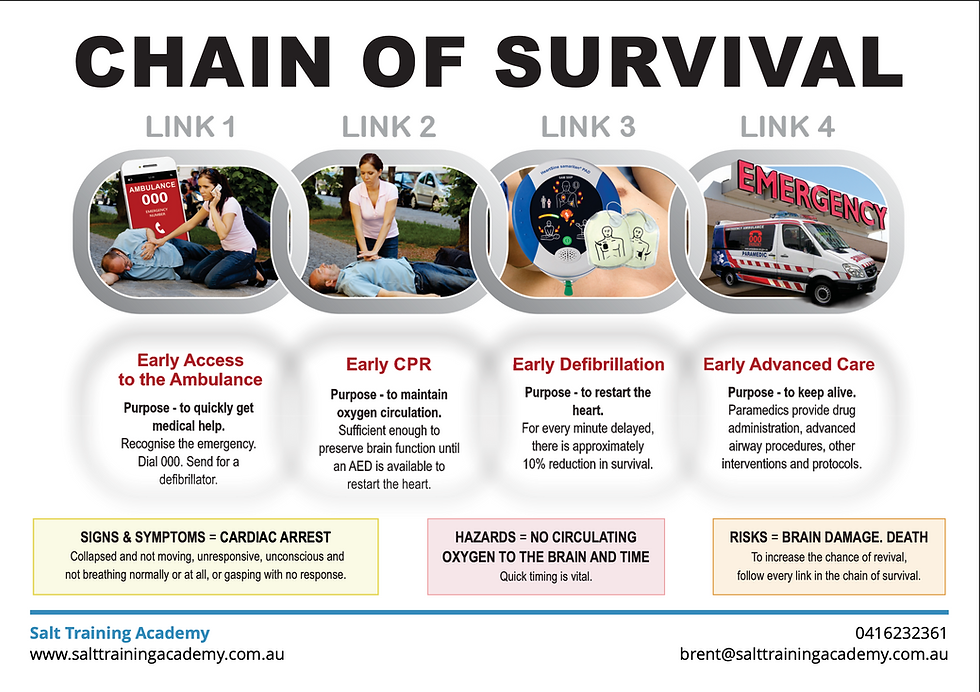
CPR and an AED work together as part of what emergency services refer to as the Chain of Survival.
The Chain of Survival
The greatest chance of survival occurs when these links happen quickly:
Recognise cardiac arrest and call Triple Zero (000).
Begin CPR immediately.
Retrieve and apply an AED as soon as possible.
Continue CPR until paramedics take over.
Receive advanced medical care.
When each link is strong, survival improves.

Does NSW Law Require Workplaces to Have an AED?
This is one of the most common questions employers ask.
In most cases, there is currently no law requiring every Australian workplace to install an AED.
However, under the Work Health and Safety Act 2011 (NSW), employers have a duty to provide adequate first aid arrangements that are appropriate for the hazards and risks of their workplace.
This means every workplace should assess whether an AED forms part of appropriate emergency preparedness.
A workplace first aid risk assessment should consider factors such as:
Number of workers.
Number of visitors or customers.
Distance from emergency medical services.
Age profile of workers.
Nature of work performed.
Physical demands of work.
Existing first aid resources.
Previous medical emergencies.
Whether the workplace is regional or remote.
An AED may be a practical and reasonable control measure depending on these factors.
Which Businesses Should Strongly Consider an AED?
Although every workplace should complete its own risk assessment, many industries are likely to benefit from having an AED readily available.
These include:
Construction companies
Manufacturing facilities
Schools
Childcare centres
Sporting clubs
Gyms and fitness centres
Caravan parks
Holiday accommodation providers
Shopping centres
Community centres
Aged care facilities
Disability support providers
Local councils
Warehouses
Large office environments
Regional workplaces with extended ambulance response times
Even low-risk workplaces may have staff, contractors or visitors with existing heart conditions that are unknown.
Can Anyone Use an AED?
Yes.
AEDs are specifically designed so they can be used by ordinary members of the public during an emergency.
Once switched on, the AED provides step-by-step voice instructions.
It automatically analyses the person's heart rhythm and will only recommend a shock if one is clinically appropriate.
It cannot accidentally shock someone whose heart does not require defibrillation.
While anyone can use an AED, CPR training gives people the confidence and practical skills to respond calmly under pressure.
Where Should an AED Be Installed?
If your workplace has an AED, it should be:
Clearly visible.
Easy to access.
Available whenever the workplace is occupied.
Mounted with recognised AED signage.
Included within emergency response procedures.
Checked and maintained according to the manufacturer's recommendations.
Known to all staff and regular visitors.
Every minute spent searching for equipment reduces valuable treatment time.
Beyond Compliance—Building a Safer Workplace
Many organisations choose to install an AED not because legislation specifically requires one, but because they recognise the value of protecting their employees, customers, contractors and visitors.
An AED demonstrates a proactive commitment to workplace health and safety.
Combined with trained first aiders, effective emergency procedures and appropriate first aid equipment, it strengthens an organisation's ability to respond confidently during a medical emergency.
Workplace AED Checklist
If you're reviewing your workplace emergency preparedness, ask yourself:
✅ Have we completed a current first aid risk assessment?
✅ Do enough staff hold current CPR and First Aid qualifications?
✅ Could an ambulance realistically reach our workplace within minutes?
✅ Would visitors know where our AED is located?
✅ Are staff confident using an AED?
✅ Is our emergency response plan regularly reviewed?
If you answered "No" to several of these questions, it may be time to review your workplace first aid arrangements.
Frequently Asked Questions
Is an AED difficult to use?
No. Modern AEDs provide clear voice instructions and automatically analyse the patient's heart rhythm before advising whether a shock is required.
Can an AED harm someone?
No. The device will only deliver a shock if it detects a shockable rhythm.
Should small businesses consider an AED?
Every workplace is different. A first aid risk assessment should help determine whether an AED is appropriate for your circumstances.
Does CPR training include AED use?
Yes. Nationally recognised CPR training includes the use of an AED as part of the management of cardiac arrest.
How SALT Training Academy Can Help
At SALT Training Academy, we work with businesses, schools, councils, sporting clubs and community organisations throughout Port Macquarie and the coastal communities throughout Hastings and the Mid North Coast to improve workplace emergency preparedness.
Training and assessment are delivered on behalf of Allens Training Pty Ltd RTO 90909 through practical, engaging training designed to build confidence—not just competency.
Whether you're reviewing your workplace first aid arrangements, updating staff qualifications or considering whether an AED is appropriate for your organisation, our experienced trainers can help you understand your responsibilities and prepare your team to respond when every second counts.
Build the Confidence to Act When Every Second Counts
Having an AED in your workplace is an important step towards improving emergency preparedness—but equipment alone isn't enough. In a real emergency, it's the confidence and actions of the people nearby that can make the greatest difference.
At SALT Training Academy, we deliver practical, nationally recognised CPR and First Aid training designed to give participants the knowledge and confidence to recognise a cardiac arrest, commence CPR immediately, safely use an Automated External Defibrillator (AED) and provide effective care until emergency services arrive.
Whether you're an individual looking to refresh your skills or an employer wanting to improve workplace safety, our experienced trainers deliver engaging, hands-on training across Port Macquarie, Wauchope, Kempsey, Bonny Hills and the Mid North Coast.
We offer:
HLTAID009 – Provide Cardiopulmonary Resuscitation (CPR) for anyone needing CPR certification or renewal.
HLTAID011 – Provide First Aid, covering CPR and the management of common medical emergencies and injuries.
HLTAID012 – Provide First Aid in an Education and Care Setting, designed for educators, childcare professionals and school staff.
Training and assessment are delivered on behalf of Allens Training Pty Ltd RTO 90909, with flexible public courses held regularly and onsite workplace training available for businesses, schools, sporting clubs and community organisations.
If it's been more than 12 months since your last CPR course, or you're unsure whether your workplace emergency response arrangements are up to date, now is the perfect time to refresh your skills.
Ready to build a safer workplace or renew your qualifications?
Explore our nationally recognised CPR, First Aid and Workplace Training courses, or contact our friendly team to discuss onsite training tailored to your organisation. The skills you learn today could help save the life of a colleague, customer, family member or friend tomorrow.
References
NSW Ambulance. Out-of-Hospital Cardiac Arrest Registry – 2024 Report.
Work Health and Safety Act 2011 (NSW).
SafeWork NSW – First Aid in the Workplace Code of Practice.
Australian Resuscitation Council Guidelines.


