The Mid North Coast Safety Handbook – Edition 8


When Someone Gets Hurt: What Should Your Workplace Actually Do?
First aid and emergency preparedness for workplaces across the Mid North Coast
Most workplaces have a first aid kit.
But if someone suddenly collapses, suffers a serious cut, falls from a height, has an allergic reaction or experiences a medical emergency, would everyone actually know what to do?
That is the question behind Edition 8 of The Mid North Coast Safety Handbook.
Because having a first aid kit on the wall is only one small part of being prepared.
A good workplace emergency response is about having the right equipment, the right people, the right procedures and the confidence to act.
🚑 First aid isn't just about having a first aid kit
Under NSW workplace safety requirements, businesses need to provide appropriate first aid equipment and facilities and, where required, access to trained first aiders.
What is appropriate depends on the workplace.
SafeWork NSW says businesses need to consider factors including:
The type of work being performed
The hazards present
The size and location of the workplace
The number and type of workers
Other people who may be present
Whether workers operate remotely or in isolation
That means the first aid needs of a small office aren't necessarily the same as those of a construction site, childcare centre, sporting club, warehouse, farm or outdoor recreation business.
There is no one-size-fits-all first aid setup.
What happens when something goes wrong?
Imagine this:
It's 10:15am.
A worker suddenly collapses.
Someone shouts for help.
People gather around.
Someone says, "Where's the first aid kit?"
Another person asks, "Who's trained in first aid?"
Someone else is trying to find the address so they can call an ambulance.
And suddenly, valuable time is being lost.
This is why emergency preparedness matters.
The goal isn't to predict exactly what will happen.
The goal is to make sure your workplace has already thought about what happens next.
1. Know where your first aid equipment is
This sounds obvious.
But ask your team:
"If someone was seriously injured right now, could you get the first aid kit within 30 seconds?"
If the answer is no, that's worth fixing.
First aid kits should be accessible and easy to identify, with consideration given to areas where injuries are more likely to occur. Mobile workers may also require portable first aid kits in their vehicles.
For larger workplaces, you may need more than one kit.
And don't forget the places your workers actually work.
A first aid kit locked inside the main office isn't particularly useful to someone working at the other end of a large site.
2. Make sure someone knows what to do
A first aid kit can't make decisions.
A trained person can.
SafeWork NSW says workplaces need an adequate number of workers trained to provide first aid, or access to appropriately trained people, based on the workplace's circumstances.
The number of first aiders required depends on factors such as workplace risk, worker numbers, shifts, location and the nature of the work.
For example, SafeWork's guidance provides different indicative ratios for low-risk, high-risk and remote high-risk workplaces.
But numbers alone aren't the whole story.
Ask yourself:
What happens when our first aider is on leave?
What happens during lunch?
What happens on night shift?
What happens when workers are spread across different locations?
What happens when we're working away from the main workplace?
Your first aid arrangements need to work when the workplace is actually operating — not just when everyone is present.
3. CPR isn't something to think about after the emergency
If someone is unconscious and not breathing normally, the response needs to happen quickly.
That means knowing:
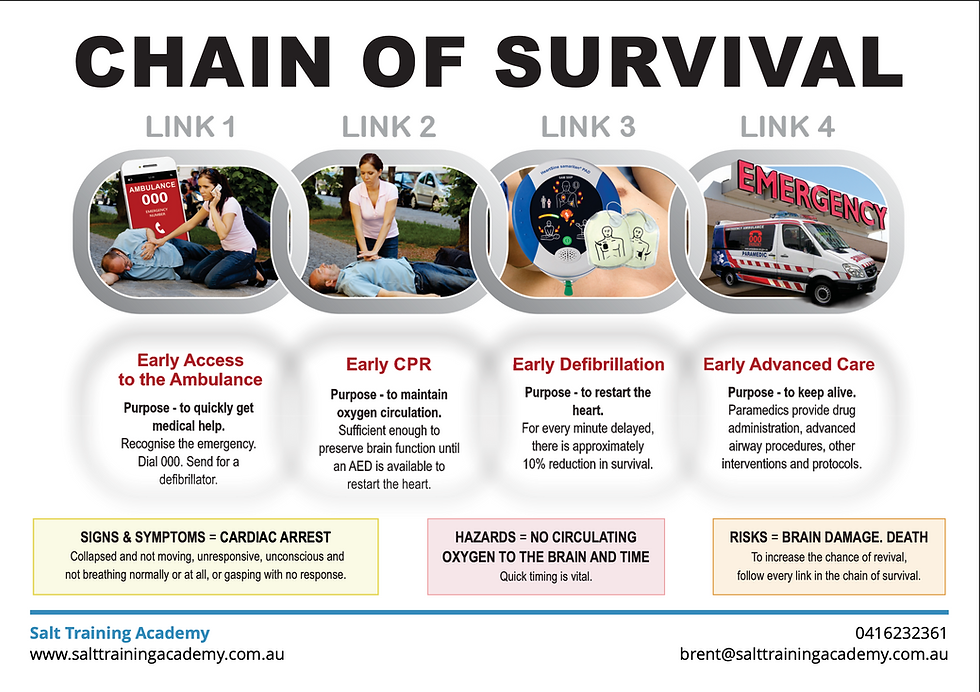
Recognise → Call 000 → Start CPR → Use an AED if available → Follow the emergency operator's instructions.
You don't need to be a medical professional to begin responding.
In an emergency, doing something is generally better than standing back because you're worried about getting it perfect.
This is one reason regular CPR training is so important.
SafeWork NSW recommends CPR refresher training annually and first aid qualifications renewed every three years.
4. Could you call an ambulance and explain exactly where you are?
This is one of the easiest things to overlook.
Particularly across the Mid North Coast.
A workplace may be:
On a rural property
At a construction site
Inside a large industrial complex
At a sporting ground
In a school
At a customer's property
On the side of the road
At a remote outdoor location
In an emergency, knowing the exact location can save valuable time.
Your emergency procedures should make it clear:
Who calls 000?
Who meets the ambulance?
Where is the best access point?
Is there a gate or security access?
What is the exact street address?
Is there anything emergency services need to know about accessing the site?
SafeWork NSW recommends emergency procedures cover effective response, evacuation, notifying emergency services as early as possible, medical treatment and effective communication.
5. Don't forget the AED
An Automated External Defibrillator (AED) can be an important part of a workplace emergency response.
AEDs are designed to provide instructions and can be used by trained or untrained people.
But simply owning one isn't enough.
If your workplace has an AED, ask:
Does everyone know where it is?
Is it accessible?
Is it clearly identified?
Do workers know how to use it?
Is it maintained?
Is it available when the workplace is operating?
We've previously explored this in more detail in our guide:
An AED should be considered as part of the overall emergency response — not as a replacement for first aid training or an emergency plan.
6. Think beyond the standard first aid kit
The traditional workplace first aid kit is designed to deal with common injuries.
But your workplace might have additional risks.
Depending on your activities, you may need to consider things such as:
Serious bleeding
Burns
Eye injuries
Chemical exposure
Allergic reactions
Asthma
Snake bites
Remote work
Outdoor work
Heat-related illness
Specific workplace hazards
SafeWork NSW specifically notes that additional equipment may be appropriate depending on the risks, including equipment for remote workplaces and certain medical emergencies.
The important point is:
Don't buy equipment because someone told you every workplace needs it.
Instead, assess your workplace and your risks.
7. What about workers who aren't at the main workplace?
This is particularly important across the Mid North Coast.
We have businesses where workers spend their day:
Travelling between customers
Working from home
Working alone
Working on farms
Working outdoors
Visiting client properties
Working on construction sites
Driving between locations
Working in remote areas
SafeWork NSW identifies remote and isolated work as presenting additional challenges because immediate access to rescue, medical or emergency services may not be available.
That means your emergency planning needs to consider where your workers actually are, not simply the address printed on your business registration.
8. Have an emergency plan — and practise it
An emergency plan shouldn't sit in a folder that nobody has opened since it was written.
Workers should understand:
What constitutes an emergency
Who takes charge
How to raise the alarm
Who contacts emergency services
Where first aid equipment is located
Where emergency exits are
Where the assembly point is
Who is responsible for particular tasks
How emergency equipment is used
What happens after the immediate emergency
SafeWork NSW states that workplaces are legally required to have an emergency plan, and the plan should be tested and reviewed.
And here's the important part:
Practise it.
Because people rarely behave exactly as expected when something goes wrong.
A simple drill can reveal problems you didn't know existed.
9. Ask your workers
One of the best ways to improve emergency preparedness is surprisingly simple:
Ask the people doing the work.
Ask them:
"If someone was seriously injured here right now, what would make it difficult to get help?"
You might discover:
The first aid kit is too far away
Nobody knows who the first aider is
The gate is normally locked
The address isn't clearly displayed
Mobile phone reception is poor
Workers don't know where the AED is
The emergency exit is blocked
New workers haven't been shown the emergency procedures
SafeWork NSW recommends consulting workers when determining first aid requirements because workers can provide valuable insight into the risks and practical arrangements at their workplace.
A 10-minute emergency readiness check
Take 10 minutes this week and walk through your workplace.
Ask:
☐ Do we have an accessible first aid kit?
☐ Is it stocked and in date?
☐ Does everyone know where it is?
☐ Do we have appropriately trained first aiders?
☐ Is there first aid coverage across different shifts or locations?
☐ Do workers know how to contact emergency services?
☐ Is our workplace address clearly available?
☐ Does everyone know where the AED is, if we have one?
☐ Do workers know our emergency procedures?
☐ Have we actually practised them?
☐ Have we considered workers who operate remotely or alone?
☐ Have we reviewed our arrangements after changes to the workplace?
If you answered no to any of these, you've just identified an opportunity to improve your workplace.
The real measure of safety
A good safety system isn't measured by how impressive the paperwork looks.
It's measured by what happens when something unexpected occurs.
When someone is injured, the first few minutes can be critical.
People need to know:
What do I do?
Who do I call?
Where is the equipment?
Who is trained?
How do we get help here?
The more familiar those answers are before an emergency occurs, the better prepared your workplace will be.
Safety across the Mid North Coast
This is where The Mid North Coast Safety Handbook starts to broaden out.
Safety isn't just about construction sites.
It's about the office in Port Macquarie, the childcare centre in Wauchope, the sporting club in Bonny Hills, the farm outside Kempsey, the school in Taree, the hospitality business in Forster and the community organisation in Crescent Head.
Different workplaces.
Different hazards.
But the same fundamental goal:
Everyone gets home safely.
At SALT Training Academy, we deliver practical safety training for workplaces, businesses, schools, community organisations and individuals across the Mid North Coast.
Our approach is simple:
Practical training. Real-world scenarios. Skills people can actually use when they matter.
Training and assessment delivered on behalf of Allens Training Pty Ltd RTO 90909.
Coming up in Edition 9
Next, we're heading outdoors.
Edition 9: Heat, Sun & Outdoor Work — Staying Safe When the Mid North Coast Heats Up
From construction sites and farms to sporting clubs, outdoor recreation and community events, heat and sun exposure can affect almost anyone working outside.
We'll look at the risks — and some practical ways workplaces can manage them.